Accreditation Erasmus +
Enhancing digital skills and competences through innovative teaching and learning methods.
Promoting the inclusion and active participation of marginalized youth.
2025-1-PL01-KA151-YOU-000300361

Enhancing digital skills and competences through innovative teaching and learning methods.
Promoting the inclusion and active participation of marginalized youth.
We are proud to announce that Autokreacja has been awarded Erasmus+ accreditation in the field of Youth for the programme period 2021–2027.
Erasmus+ accreditation is a
meets the high standards of the Erasmus+ programme,
has a clear long-term strategy for international cooperation,
is committed to inclusion, sustainability, and active citizenship,
ensures quality, transparency, and accessibility in all mobility activities.

The activity will be based on an inclusive approach, ensuring access for diverse participants

This activity will promote youth participation in democratic life, support social and civic engagement, and strive to ensure that all young people have the means necessary to take part in social life.

This activity will address one or more of the EU Youth Goals. Where applicable, detailed information is provided in the documentation published by the National Agency.”

Drawn Together: Visual Tools for Youth Work was a seven-day training course for facilitators, trainers, youth workers, and activists who wanted to explore new methods for delivering knowledge to learners, especially those at risk of exclusion. We believed that education could be fun and that there were many creative ways to make it more effective.
That is why, during our training, we focused on understanding what graphic facilitation was and how to find a visual language that, in an easy but powerful way, helped us make our working materials and presentations more exciting and effective.
More on dedicated page. click and see details
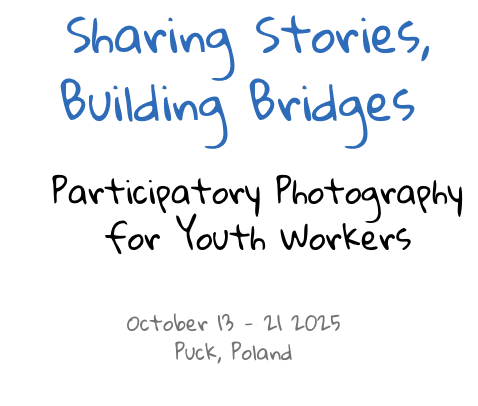
Sharing Stories, Building Bridges – Participatory Photography for Youth Workers was a 7-day training course focused on providing participating youth workers with digital-based tools and methods that could be used to support their young beneficiaries, especially those at risk of exclusion.
The main method explored during the course was participatory photography, a visual approach that acknowledged individuals as experts in their own lives. Unlike traditional photography, where subjects were passively portrayed by external photographers, participatory photography empowered individuals to capture and narrate their own stories. This approach shifted creative control from the photographer to the participants, fostering self-advocacy and offering audiences a more authentic understanding of diverse lives and needs.
Click me! more on dedicated page.About
A key aim of the project was to build digital agency among young people. By raising awareness and fostering critical thinking, participants were empowered to take back control over their relationship with technology. Instead of automatically reaching for their “glowing rectangles,” they learned to make conscious, intentional choices about their digital behavior.
The project also introduced practices of digital detox and mindfulness. Through guided activities, participants experienced the benefits of disconnecting from screens and reconnecting with themselves and their surroundings. Offline tools, such as outdoor Forest Power Cards (“Forest Meditations”), were used to strengthen authentic peer connections, support stress management, and encourage presence in the “here and now.”
Click me!

ABOUT
Everyone has a story to tell, and we believe that all personal stories – no matter how big or small – are worth sharing with the world. Working with participatory audio narratives is a way of providing young people with an opportunity to reflect upon their experiences and emotions and tell their unique personal stories using digital means of expressions – in this case audio recordings.
Participating representatives of different NGOs from the European Union and the Eastern Partnership region had a chance to explore how digital based tools and methods (audio / voice recording / storytelling) can be used to support their young beneficiaries, especially young people at risk of exclusion. During the training, we engaged in various types activities, exploring both theoretical and practical aspects of the topic
Click me!


ABOUT
The Power of Stories – Digital Storytelling for Youth Workers was a 7 days long training course focused on providing the participating youth workers with knowledge and skills related to digital storytelling and other participatory media methods. The main aim of the project was to open up a discussion on how digital based tools and methodologies can be used in youth work, especially in the context of supporting young people at risk of exclusion by providing them with opportunities to raise their own voices and share stories that are important for them. The main method we explored was digital storytelling (Berkeley Method) – it is an educational approach that acknowledges individuals as experts in their own lives, providing them with space to create films that show their unique, personal perspectives and live stories

ABOUT
(Creative) Writing in the Digital World was a 6-day youth exchange focused on writing as an inseparable part of daily life in the digital era. During the project, participants from Armenia, Lithuania, Poland, and Ukraine worked together using different creative methods and tools to enrich their writing and make it a medium through which they could express themselves in the most authentic and suitable way. The main goal was to break the cycle of constant and unconscious typing and introduce creative writing into everyday practice.